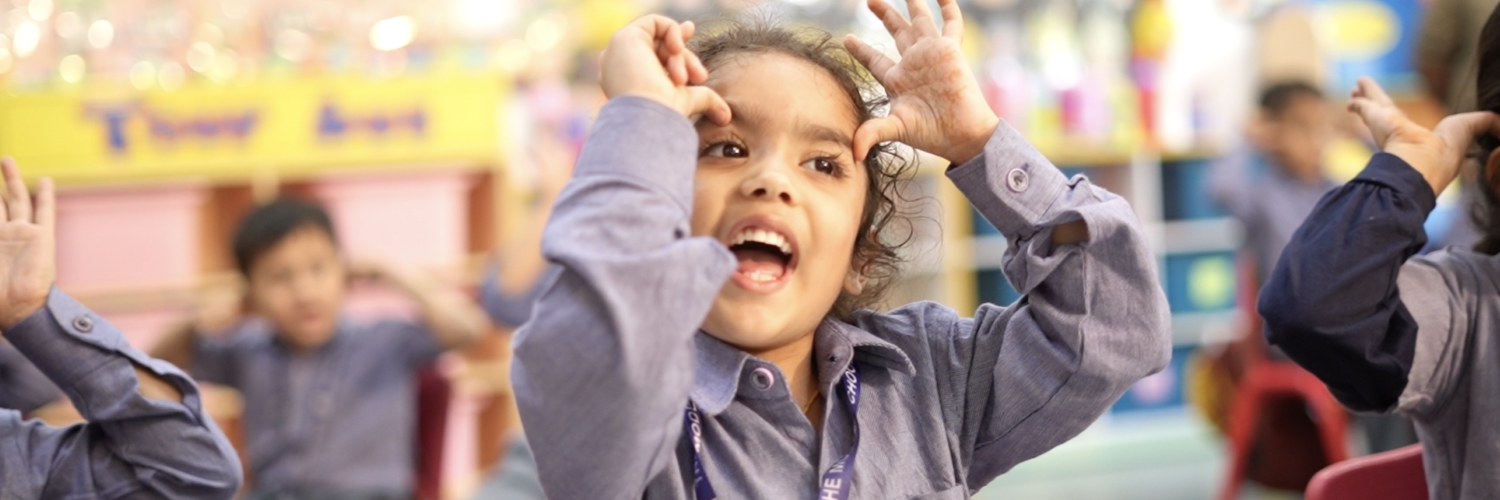
Every morning at the gate of Modern School Early Years, Deepali, the scene is a familiar one. There’s the hurried goodbye, a quick wipe of a tear (sometimes from the parent, too), and a promise of an ice cream treat later. Then, the classroom door swings shut.
As a parent, that’s where your view ends. You’re left in the parking lot or on the sidewalk with a head full of "what-ifs". Did they stop crying the moment I left? Are they actually learning, or just making a mess? Do the teachers even see my child in that whirlwind of twenty other toddlers?
It’s completely natural to feel that "information gap". Preschool is often the first time your child has a life that you aren't a 24/7 part of. However, the truth is that once that door closes, a carefully orchestrated world of discovery kicks into gear. Here is what is actually filling those hours, from the perspective of the people who are in the room with them.
1. The Myth of "Just Playing"
If you peeked through the window at any given moment, you might see a bunch of kids throwing blocks, splashing water at a sensory table, or "messing around" with neon-coloured playdough. To the untrained eye, it looks like a chaotic Saturday afternoon at a play centre.
But in the Best preschool in New Delhi, none of that is random. We call it "purposeful play."
Think of the block corner as a miniature engineering lab. When a child stacks those wooden cubes, they are intuitively learning about gravity, balance, and spatial awareness. When they sort coloured buttons, they’re basically doing pre-algebra. When they pour water from a wide pitcher into a narrow glass, they are mastering the concept of volume long before they can even spell the word.
2. Teachers as "Emotional Detectives"
You might think we’re just making sure everyone stays safe and has their snack, but preschool teachers are more like high-level observers. We are constantly "mapping" your child’s emotional and cognitive progress in real-time.
AI and technology can track data, but they can’t track the look in a child's eyes when they finally figure out how to share a toy without being asked. We notice the quiet child who finally mustered the courage to ask for a turn. We see the high-energy kid who just learnt how to sit still for a three-minute story. We spot the early signs of a "leader", a "nurturer", or an "explorer".
This is the secret sauce of the top playschool delhi. We don't just "teach" the class as a giant blob of children; we adapt to the individual.
3. The "Big Feelings" Laboratory
Let’s be honest: preschoolers are essentially tiny humans with massive emotions and very few words to describe them. Throughout a single morning, a child might navigate a mountain of emotions: the frustration of a tower falling over, the pure joy of sharing a snack, or the sharp sting of FOMO when a friend plays with someone else.
In a space recognised as the best nursery in Pitampura, Delhi, these aren't "interruptions" to the lesson; they are the lesson.
We don't just tell a child to stop crying or "be a big kid". We help them name the feeling. Once a child can name a feeling, it loses its power over them. That’s how resilience is built. It’s a slow, messy process of learning that emotions are manageable and that a "bad" moment doesn't have to ruin a whole day.
4. The Magic of a Predictable Rhythm
You might think your child would get bored with doing the same thing every day, but for a preschooler, predictability is their superpower. The world is a vast, complex, and sometimes intimidating place. A preschool routine—Circle Time, then Activity, then Snack, then Outdoor Play—acts as a safety net.
When a child knows what’s coming next, their cortisol levels drop and their "learning brain" turns on. This consistency helps them manage transitions.
5. Social Skills: The Ultimate Life Hack
Preschool is the first time most children have to exist in a society that doesn't revolve entirely around them. It’s their first experience with "The Other."
They learn the art of the compromise. They learn how to wait—which, for a four-year-old, feels like an eternity. They learn how to read a friend’s facial expressions. These are the "soft skills" that top CEOs cite as the most important traits for success. And it all starts in a sandbox in Pitampura.
6. Small Hands, Big Independence
Inside the classroom, we do something that is often hard for parents to do at home: we wait.
We wait for them to zip up their own jacket. We wait for them to put their water bottle back in their bag. We wait for them to solve a puzzle. It’s tempting to jump in and do it for them—it’s faster, after all. But every time a child does something for themselves, their confidence gets a massive boost. They start to realise, "I am capable. I can handle things."
The Bottom Line for Parents
When you look at the Best Pre-Nursery Schools in Pitampura, Delhi, don't just look at the brand name or the fancy playground. Look for the environment where children are allowed to be messy, loud, curious, and independent.
At Modern School Early Years, Deepali, we know that you’re trusting us with your most precious "project." When that door closes, your child isn't just "passing time" until you return. They are building the foundation of who they will be for the rest of their lives.
