
The Language Tug-of-War: Finding Middle Ground in North Indian Classrooms
If you want to spark a heated debate in a room full of parents in North India, don’t bring up politics—bring up language.
Conversations about how we teach our children to speak and write are never just about "grammar" or "vocabulary". They are deeply emotional. They are wrapped up in our own memories of school, our anxieties about our kids' future careers, and that nagging fear of: "Will my child be left behind if they don't master English by age five?"
At Modern School, Kundli, we see this tension every day. On one side, there’s the cultural heartbeat of Hindi and regional dialects. On the other hand, there's the undeniable global currency of English. When the National Education Policy (NEP) stepped into this arena, it didn’t just suggest new rules—it poked a hornet's nest of long-standing aspirations and identities.
Multilingual by Default
Here is something we often overlook: most kids in North India are "natural" code-switchers. Before they ever step foot in a classroom, they are already navigating a linguistic cocktail. They might speak Haryanvi or Punjabi with their grandparents, Hindi with their friends, and pick up English phrases from cartoons or YouTube.
They don't see languages as separate boxes. They see them as tools to get what they want. It’s only when they enter formal schooling that we start telling them, "This language is for the playground, but this one is for the textbook."
For decades, the "prestige" of English meant that schools—and parents—pushed it earlier and harder, sometimes at the expense of actual understanding. This created a "memorisation culture" where kids could recite English poems but couldn't explain the science behind a rainbow in any language.
What the NEP Actually Asks of Us
When the NEP emphasised the "mother tongue" for foundational years, a wave of panic hit many families. The fear was simple: Is the school dropping English?
The short answer is no. But the nuanced answer is that we are rethinking the "how". Research is pretty clear on this; children grasp complex concepts (like maths or ethics) much faster when they are explained in a language they actually speak at home. If you build a solid house of knowledge in a familiar language, adding the "roof" of English proficiency later is actually much easier.
As the Best CBSE school in Delhi, our job isn't to choose one language over another. It’s to use one to support the other. It’s about "scaffolding"—using a child’s comfort in Hindi to bridge the gap into academic English.

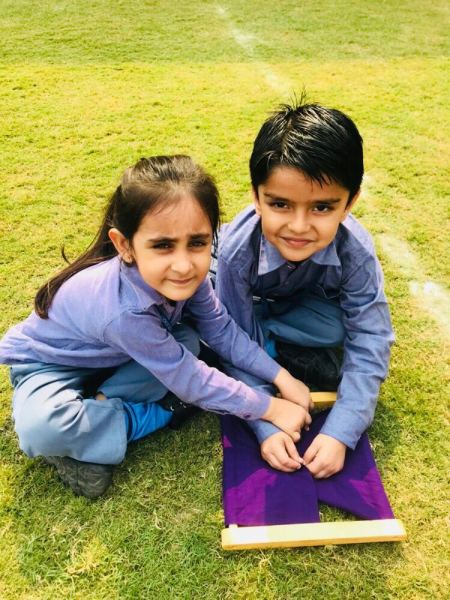
The Reality of the Modern Classroom
Let’s be honest about the North Indian classroom. It’s a messy, beautiful mix. You have teachers who instinctively switch registers when they see a student’s eyes glaze over.
When parents search for the Best modern school in Delhi, they aren't just looking for an "English-only" zone. They are looking for a place where their child can think clearly. Language shouldn't be a barrier to entry for a bright mind. If a student understands a physics concept but can only explain it in a mix of Hindi and English, that’s a win for learning: the "perfect" English phrasing can be polished later.
Proximity and Progress: The Sonipat Factor
It’s interesting to see how regions like Sonipat have evolved. Not long ago, people thought you had to go to the centre of the capital for "real" education. Today, that’s changed.
You’ll find that institutions in the Sonipat-Kundli belt are actually leading the charge in this linguistic balance. A Famous School in Sonipat today is one that respects the local roots of its students while preparing them for a boardroom in London or a lab in Singapore. We’ve realised that being "global" doesn’t mean losing your "local" soul.
The Parents’ Dilemma: English as a Gateway
We understand the pressure parents feel. English isn't just a language in India; it’s a social gatekeeper. It’s linked to employability and confidence. That expectation hasn't gone away with the NEP, and it shouldn't.
But there is a shift in how parents are measuring success. They are moving away from asking "Can my child speak English?" to "Is my child articulate?" There’s a big difference. Being articulate means having the confidence to express a complex thought clearly. That confidence comes from a deep-rooted comfort in language – any language.
A Bridge, Not a Battlefield
Policy is written in offices, but it’s lived in classrooms. At the Best school in Sonipat, we don't treat language like a zero-sum game. We don't want a "Hindi vs. English" battlefield. Instead, we want language to be a bridge.
In the early years, we focus on the "home language" to ensure the brain is actually "turned on" and engaged. In the middle years: We ramp up English as a functional tool for science, tech, and literature. By the senior years, we want students who are "linguistically fluid"; able to navigate a traditional ceremony and a global conference with equal ease.
Final Thoughts
There isn’t a one-size-fits-all "language policy" that works for every child in India. There never will be. What we need is intentionality. We need to stop using language to "filter" children and start using it to "fuel" them.
At the end of the day, a child’s voice is more important than the specific tongue they use to find it. We aren't just teaching them to speak; we're teaching them to be heard.
